
 HONG KONG SAUL
DS2020FEXBG4 Turbine Control System
DS2020FEXBG4 Product Introduction
Basic Information
Brand: GE (General Electric)
Model:DS2020FEXBG4
Part Number: DS2020FEXBG4
Series: Mark VIe Speedtronic Turbine Control System I/O Pack
Country of Origin: United States
Product Type: Discrete Input Module (Contact Input Module), also known as PDIA I/O Pack
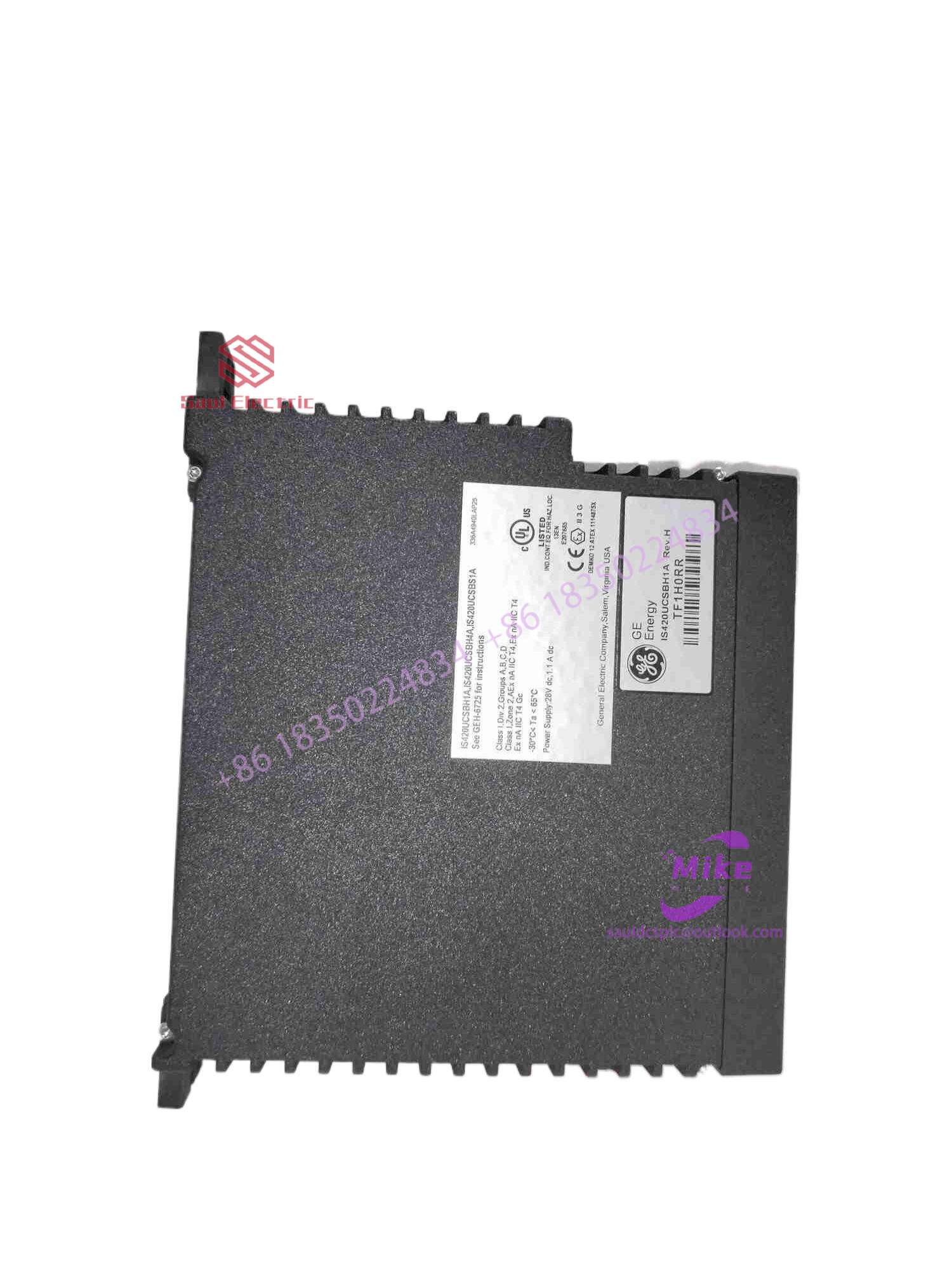 Functional Overview
The DS2020FEXBG4 is a 24-channel discrete (digital) input module in the GE Mark VIe control system. Its primary function is to collect discrete signals (contact open/close signals) generated by field devices such as sensors,
switches, and relays, convert them into digital signals that can be recognized and processed by the PLC or control system CPU,
and transmit the processed data to the GE Speedtronic turbine control system or other control equipment, enabling automated control and monitoring. Key Technical Specifications
Rated Voltage: 24.0 VDC (Nominal)
Maximum Rated Voltage: 28.6 VDC
Maximum Rated Contact Input Voltage: 32 VDC
Number of Input Channels: 24 Discrete Inputs
Operating Temperature Range: -30°C to +65°C
Environmental Adaptability: Passes rigorous environmental testing, capable of long-term stable operation in harsh industrial environments Compatible Terminal Boards
The DS2020FEXBG4 can be paired with a variety of GE terminal boards, including but not limited to:
IS200STCIH1A / IS200STCIH2A
IS200STCIH8A
IS200TBCIH2C / IS200TBCIH4C
IS400STCIH1A / IS400STCIH2A / IS400STCIH8A
IS400TBCIH2C Certifications and Safety
This module is UL certified and can be used in both hazardous and non-hazardous locations. The UL certification covers various classes and divisions, and relevant UL mark documents are available for reference.
Analysis of demand for industrial robots in the automotive industry
The automotive industry remains the largest robot application industry globally, with a share of almost 30% of total supply. Investment in new automotive production capacity and modernization processes have driven the automotive industry’s demand for robots. The use of new materials, the development of energy-saving drive systems, and fierce competition among major automotive markets are the fundamental driving forces for the extensive use of industrial robots in the automotive industry.
According to OICA statistics, 79% of the installed capacity of industrial robots in the automotive industry is distributed in 5 key markets: China (39,351 units), Japan (17,346 units), Germany (15,673 units), the United States (15,246 units), and South Korea (11,034 units) .
In 2019, the year-on-year growth in fixed asset investment in my country’s automobile industry was around 0%, and the overall situation was sluggish. This is also the lowest situation in recent years. It is predicted that with my country’s automobile sales stabilizing in 2020, fixed asset investment is expected to bottom out and rebound, driving the industrial robot industry to pick up.
Breakdown of industrial robot status in 3C industry
3C is the collective name for computer , communication and consumer electronic products, also known as “information appliances”. Such as computers, tablets, mobile phones or digital audio players. The 3C industry is another important source of demand for industrial robots.
In 2018, the global demand for electronic equipment and components continued to decrease, and the Sino-US trade friction had a direct impact on Asia. Asia is an important production base for global electronic products and components. The highest installed capacity of robots in the 3C industry reached 122,000 units in 2017. , dropped to 105,000 units in 2018. The installed robot capacity in the 3C sub-industry mainly comes from three countries: China (43%), South Korea (19%), and Japan (17%).
In addition, 5G from the three major operators will enter commercial application in the second half of 2019. In November 2019, the overall domestic smartphone market shipped 130.47 million units, a year-on-year decrease of 1.3%. However, the growth rate has improved significantly compared with the 10.7% year-on-year decline in August. The innovation brought by 5G to smartphones will not only increase smartphone shipments, but will also drive upgrading of mobile phone technology (TWS headsets, TOF lenses, etc.), which can drive demand for 3C automation equipment and thereby increase industrial robot shipments.
According to data from the China Business Industry Research Institute, in 2017, my country’s industrial robot applications in the above fields accounted for 33.30%, 27.7%, 10.8%, 7.9%, and 2.3% respectively, of which the automotive industry and 3C accounted for more than 60%. At present, both automobiles and 3C have bottomed out and are rebounding, with obvious signs of improvement in demand. It is expected that the industrial robot industry chain will rebound in 2020. In addition to the automobile and 3C industries, the downstream application fields of industrial robots also include metal processing, plastics and chemicals, food, beverages, tobacco and other industries. The market demand for industrial robots will continue to expand in the future.

There are no reviews yet.