
 HONG KONG SAUL

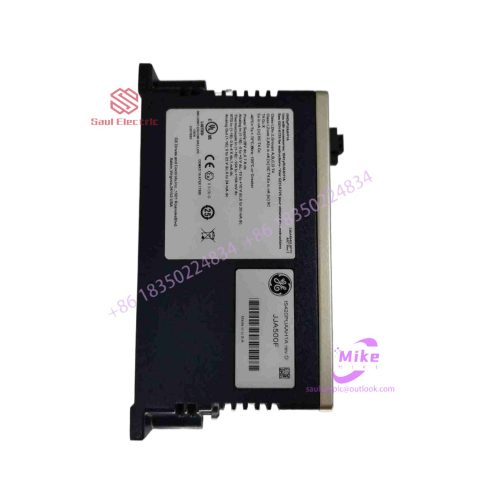
IS23OSTTCH2A integrated circuit board
IS23OSTTCH2A Product Introduction
Basic Information
Brand: GE (General Electric)
Model:IS23OSTTCH2A
Part Number: IS23OSTTCH2A
Series: Mark VIe Speedtronic Turbine Control System I/O Pack
Country of Origin: United States
Product Type: Discrete Input Module (Contact Input Module), also known as PDIA I/O Pack
 Functional Overview
The IS23OSTTCH2A is a 24-channel discrete (digital) input module in the GE Mark VIe control system. Its primary function is to collect discrete signals (contact open/close signals) generated by field devices such as sensors,
switches, and relays, convert them into digital signals that can be recognized and processed by the PLC or control system CPU,
and transmit the processed data to the GE Speedtronic turbine control system or other control equipment, enabling automated control and monitoring. Key Technical Specifications
Rated Voltage: 24.0 VDC (Nominal)
Maximum Rated Voltage: 28.6 VDC
Maximum Rated Contact Input Voltage: 32 VDC
Number of Input Channels: 24 Discrete Inputs
Operating Temperature Range: -30°C to +65°C
Environmental Adaptability: Passes rigorous environmental testing, capable of long-term stable operation in harsh industrial environments Compatible Terminal Boards
The IS23OSTTCH2A can be paired with a variety of GE terminal boards, including but not limited to:
IS200STCIH1A / IS200STCIH2A
IS200STCIH8A
IS200TBCIH2C / IS200TBCIH4C
IS400STCIH1A / IS400STCIH2A / IS400STCIH8A
IS400TBCIH2C Certifications and Safety
This module is UL certified and can be used in both hazardous and non-hazardous locations. The UL certification covers various classes and divisions, and relevant UL mark documents are available for reference.
(5) Perform predictive maintenance, analyze machine operating conditions, determine the main causes of failures, and predict component failures to avoid unplanned downtime.
Traditional quality improvement programs include Six Sigma, Deming Cycle, Total Quality Management (TQM), and Dorian Scheinin’s Statistical Engineering (SE) [6]. Methods developed in the 1980s and 1990s are typically applied to small amounts of data and find univariate relationships between participating factors. The use of the MapReduce paradigm to simplify data processing in large data sets and its further development have led to the mainstream proliferation of big data analytics [7]. Along with the development of machine learning technology, the development of big data analytics has provided a series of new tools that can be applied to manufacturing analysis. These capabilities include the ability to analyze gigabytes of data in batch and streaming modes, the ability to find complex multivariate nonlinear relationships among many variables, and machine learning algorithms that separate causation from correlation.
Millions of parts are produced on production lines, and data on thousands of process and quality measurements are collected for them, which is important for improving quality and reducing costs. Design of experiments (DoE), which repeatedly explores thousands of causes through controlled experiments, is often too time-consuming and costly. Manufacturing experts rely on their domain knowledge to detect key factors that may affect quality and then run DoEs based on these factors. Advances in big data analytics and machine learning enable the detection of critical factors that effectively impact quality and yield. This, combined with domain knowledge, enables rapid detection of root causes of failures. However, there are some unique data science challenges in manufacturing.
(1) Unequal costs of false alarms and false negatives. When calculating accuracy, it must be recognized that false alarms and false negatives may have unequal costs. Suppose a false negative is a bad part/instance that was wrongly predicted to be good. Additionally, assume that a false alarm is a good part that was incorrectly predicted as bad. Assuming further that the parts produced are safety critical, incorrectly predicting that bad parts are good (false negatives) can put human lives at risk. Therefore, false negatives can be much more costly than false alarms. This trade-off needs to be considered when translating business goals into technical goals and candidate evaluation methods.

There are no reviews yet.